

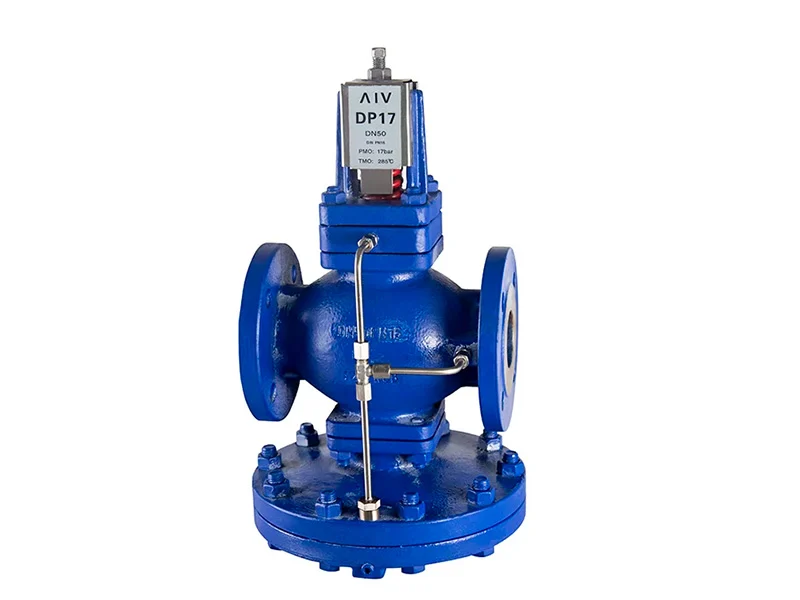
Pilot-operated pressure reducing valves are an ideal choice when you require the high precision (±1% to ±5%) typical of pneumatic control loops, yet lack access to compressed instrument air or an electrical power supply. But what exactly is a pilot-operated pressure reducing valve?
This article provides a detailed overview, covering what these valves are, how they function, and when they should be used.
What Is a Pilot-Operated Pressure Reducing Valve?
A pilot-operated pressure reducing valve utilizes a two-stage control structure—consisting of a pilot valve and a main valve. The pilot valve precisely senses the outlet pressure and drives the main valve spool to automatically adjust its opening. This reduces high-pressure media (ranging from 0.1 to 40 MPa at the inlet) to a stable, lower pressure required downstream, achieving a pressure regulation accuracy of up to ±1%.
This design overcomes the limitations of direct-acting pressure reducing valves, which struggle to maintain stable pressure at high flow rates or require excessively large springs for high-pressure applications. Pilot-operated valves can accommodate large-bore piping (DN25 to DN200) without the need for massive adjustment springs and are compatible with various media, including water, gases, steam, and hydraulic oil.
How It Works
Pilot-operated pressure reducing valves function based on hydraulic principles. Acting as a component for pressure adjustment and throttling, the valve reduces the inlet pressure to a specific, pre-set outlet pressure range. It then leverages the energy of the medium itself to automatically maintain a stable outlet pressure.
Initial Standby State: When the outlet pressure is below the set value, the pilot valve remains fully closed due to the force of its spring. The pressure in the upper and lower chambers of the main valve spool is balanced, keeping the main valve port fully open; the medium passes through without any pressure reduction.
Pressure Build-up Phase: Rotating the adjustment screw clockwise compresses the pilot spring, which pushes the pilot valve spool open. A small amount of the medium flows through the pilot valve into the upper chamber of the main valve spool, forcing the spool downward. This gradually narrows the main valve port, causing the medium to be throttled and its pressure reduced.
Stable, Balanced State: When the outlet pressure rises to the set value, the feedback channel transmits this pressure to the underside of the pilot valve diaphragm. The resulting upward force balances the force of the pilot spring, stabilizing the opening of the pilot valve and fixing the position of the main valve spool, thereby keeping the outlet pressure constant.
Dynamic Adjustment Phase: If the inlet pressure increases or the downstream flow rate decreases, the outlet pressure will rise momentarily. The pilot valve automatically opens wider, increasing the pressure in the chamber above the main valve spool; this causes the main valve port to close slightly, offsetting the pressure fluctuation. Conversely, if the outlet pressure drops, the main valve port opens wider to prevent a further decline, ensuring consistent pressure at all times.
When Is a Pilot-Operated Pressure Reducing Valve Needed?
Consider a pilot-operated pressure reducing valve if you encounter the following:
- You have already installed a direct-acting pressure reducing valve, yet the outlet pressure fluctuates by more than 10% in response to inlet pressure changes and cannot be stabilized near the set value.
- System pressure drops by more than 20% during the simultaneous startup of multiple pieces of equipment, making it impossible to maintain the required operating pressure.
- Adjusting the valve’s pressure-setting knob results in a delayed response or “sticking,” making it difficult to precisely lock in the target pressure.
- The project requirements specify that the valve must operate continuously for at least three years without the need for maintenance.
- The system frequently experiences “water hammer” (pressure surges), which standard pressure reducing valves cannot adequately buffer, leading to recurring damage to piping and seals.
If your current project faces any of these issues, a pilot-operated pressure reducing valve is the appropriate solution.
Advantages of Pilot-Operated Pressure Reducing Valves
Higher Flow Capacity
Pilot-operated pressure reducing valves are engineered for the efficient handling of high flow rates. By separating the pilot valve from the main valve, these units can manage significantly larger volumes of fluid without compromising control precision or stability. Consequently, they are ideally suited for pipelines or systems characterized by high and variable flow rates.
Stable and Precise Pressure Control
In high-flow systems, pressure and demand often fluctuate rapidly. The pilot-operated design allows the valve to sense pressure variations via the pilot mechanism and make swift adjustments to the main valve, ensuring precise control over downstream pressure. This maintains a stable outlet pressure even when upstream pressure fluctuates or downstream flow demand changes.
Reduced Wear and Longer Service Life
Because the pilot valve handles the regulation of the main valve—rather than the main valve responding directly to pressure fluctuations—the main valve is subjected to less mechanical stress and wear. This reduction in wear extends the service life of the pressure-regulating valve, making pilot-operated pressure-reducing valves both more durable and cost-effective for long-term, high-load operations.
Lower Actuation Force and Reduced Maintenance
The pilot valve requires less force to actuate the main valve, which lowers the overall mechanical force needed for operation. This not only ensures quieter performance but also extends maintenance intervals—a critical advantage for key infrastructure or remote facilities where downtime carries high costs.
Higher Sensitivity and Faster Response
Pilot-operated pressure-reducing valves can detect and respond to even the slightest pressure changes with exceptional sensitivity. This rapid response capability is vital in high-flow applications, where even minor pressure fluctuations could compromise system performance, safety, or product quality.
Flexibility and Adaptability
Thanks to their pilot-operated design, setpoints and response characteristics can be adjusted with ease; many models also support remote adjustment or configuration via external accessories. This flexibility allows operators to optimize system performance without the need to replace equipment—a significant benefit in dynamic industrial environments.
Summary
Pilot-operated pressure-reducing valves are widely used in high-flow applications, such as municipal secondary water supply systems, industrial hydraulic systems, and long-distance natural gas pipelines. Capable of maintaining a stable outlet pressure even when inlet pressure fluctuates significantly or flow rates change frequently, they serve as essential components for pressure control in both industrial and public utility sectors.
If you are looking for the right pilot-operated pressure-reducing valve for your project, AIV is the ideal partner for you. Please feel free to contact us at any time.